Before we start let's run through some terms...
-- A repetition: Doing a pose or transition once.
-- A sequence: Doing different poses one after another.
-- A session: Begins when you first step onto the mat. Finishes at Savasana. Onward!...
Some yogis attain a certain level of ability...then stay there. So.
How do you keep it moving along? Try this...
For new poses that you are not yet proficient at, literally practice repetitions.
Say you want to go from boat (Navasana) back to plank (or better still up to handstand, then to plank). This is sometimes called a jump-back.
Each yoga session, you might practice this 5 or 10 times. Do this until you can more or less do this successfully each rep.
Once you are practicing the move successfully, move it into your sequence (which is a series of poses that are the upper end of your ability).
If the new move is say a twist, then you can maybe look at taking out of your sequence an old twist and replacing it with the new twist that you are now nailing.
So, you can see how you are cycling into your yoga session new poses that you can't yet do (as reps), and you are replacing poses of the same type .e.g a back bend for a back bend in your sequence.
You're also moving out old stuff you can do pretty well.
You can specialize with the new stuff, but your sequence should have at least one of everything .i.e. a side stretch, forward fold, back bend, twist, hip opener, balance etc.
New stuff that doesn't lead itself to reps .e.g. the splits, can just be practiced in the sequence.
CU in class with your new moves, J
Wednesday, 21 June 2017

Friday, 12 May 2017
The Best You, You Can Be, For You
What's the best you, you can be, for you? An unusual question. Like an onion...there's layers.
Each time you have an answer, wait 5, then come back to it.
...see, told you!
Yoga's a solitary practice. We turn inward.
So, asking yourself what's the best you you can be, for you...well, that's about as internally focussed as you can get.
See you being you, J
Each time you have an answer, wait 5, then come back to it.
...see, told you!
Yoga's a solitary practice. We turn inward.
So, asking yourself what's the best you you can be, for you...well, that's about as internally focussed as you can get.
See you being you, J
Tuesday, 2 May 2017
Yoga With Curvature Of The Spine
While our spines naturally curve from front to back (thoracic, or upper back) and from back to front (lumbar, or lower back), it doesn't (or shouldn't) curve from left to right.
If it does (left to right) then this is scoliosis, and it can be, well ...a pain in the back.

No need to rush out and get x-rays and stuff yet. You'll know about it well enough when you start working asymmetrical back bends in earnest. You know...
...like bound dancer's pose (Badha Natarajasana).

...or a bound low lunge (Badha Anjaneyasana), or some other asymmetrical backbend pretzel concoction.

You see how the guy and girl in the pics are working the backbend more down the bound side?
If you have scoliosis and you work these types of poses, chances are you are going to feel pain. And not the good sort.
I'd like to be all yoga messianic and tell you the answer to this conundrum, but unfortunately, I'm not there yet. Good news tho'...
...you can still do symmetrical back bends (that's bending front to back) to the point of doing drop-backs and other funky moves.
The point of this post though, is to alert you to pain on one side of your back when you start down the asymmetrical path.
If you do get pain once you start working these poses in earnest, then it's off to get xrays to confirm the condition. Then it's laying off them 'till it's all straightened out (yep, another pun).
See you in class doing asymmetrical backbends (unless they hurt),
J
If it does (left to right) then this is scoliosis, and it can be, well ...a pain in the back.

No need to rush out and get x-rays and stuff yet. You'll know about it well enough when you start working asymmetrical back bends in earnest. You know...
...like bound dancer's pose (Badha Natarajasana).

...or a bound low lunge (Badha Anjaneyasana), or some other asymmetrical backbend pretzel concoction.
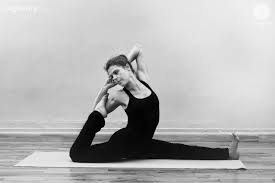
You see how the guy and girl in the pics are working the backbend more down the bound side?
If you have scoliosis and you work these types of poses, chances are you are going to feel pain. And not the good sort.
I'd like to be all yoga messianic and tell you the answer to this conundrum, but unfortunately, I'm not there yet. Good news tho'...
...you can still do symmetrical back bends (that's bending front to back) to the point of doing drop-backs and other funky moves.
The point of this post though, is to alert you to pain on one side of your back when you start down the asymmetrical path.
If you do get pain once you start working these poses in earnest, then it's off to get xrays to confirm the condition. Then it's laying off them 'till it's all straightened out (yep, another pun).
See you in class doing asymmetrical backbends (unless they hurt),
J
Friday, 6 January 2017
How to Keep Yoga Interesting
You gotta love teachers who keep it interesting.
Keeping yoga interesting, keeps you coming back. Win-win.
Trouble is...that isn't really yoga. Lemme explain...
What're you concerned about when you're practicing yoga? Where's your focus?
Breath. Bingo!
If you're focussed on your breath, what changes from session to session? Nothing. Yup...
It literally takes years to open your body. It'd be more interesting sitting watching an orchid bloom.
Only we aren't sitting watching. Our mind is laser focussed on the breath.
Yoga is neither boring nor interesting. It just is.
CU in class, just being, J.
Keeping yoga interesting, keeps you coming back. Win-win.
Trouble is...that isn't really yoga. Lemme explain...
What're you concerned about when you're practicing yoga? Where's your focus?
Breath. Bingo!
If you're focussed on your breath, what changes from session to session? Nothing. Yup...
It literally takes years to open your body. It'd be more interesting sitting watching an orchid bloom.
Only we aren't sitting watching. Our mind is laser focussed on the breath.
Yoga is neither boring nor interesting. It just is.
CU in class, just being, J.
When Is a Yogi a Yogi?
When do you know you're a yogi?
Three classes per week? Four? Five years practice? Ten?
It's not really the number of classes, or length of time practicing - although that will eventually affect you. It's attitudinal.
But it's not your attitude to yoga. It's how yoga changes your attitude or approach to other things.
When you find yourself at work saying "Whatever will happen will happen"...and previously you were this ultra-OCD person, then unfortunately, yeah, you're a yogi.
It'll get you eventually, if you keep coming back, J.
Three classes per week? Four? Five years practice? Ten?
It's not really the number of classes, or length of time practicing - although that will eventually affect you. It's attitudinal.
But it's not your attitude to yoga. It's how yoga changes your attitude or approach to other things.
When you find yourself at work saying "Whatever will happen will happen"...and previously you were this ultra-OCD person, then unfortunately, yeah, you're a yogi.
It'll get you eventually, if you keep coming back, J.
Saturday, 8 October 2016
What You Really Learn Doing Yoga
A really important thing to know about yoga, is that it's a solitary endeavor. I know, I know.
You're thinking that there's another dozen or so people in class. How can yoga be solitary?
Well, assuming you've managed to close down your senses, and you're totally focussed. Then, there really isn't anyone else. It's just you and your breath.
So, there is only one answer, to what you could possibly be learning in yoga. Because there's only one thing that there is, to actually learn about ...YOU.
You see, yoga's not about poses or breath, it's about knowing about yourself. Your body. Your mind. Your senses.
Yoga is an exploration of you. That's it!
CU in class, learning about yourself, J.
You're thinking that there's another dozen or so people in class. How can yoga be solitary?
Well, assuming you've managed to close down your senses, and you're totally focussed. Then, there really isn't anyone else. It's just you and your breath.
So, there is only one answer, to what you could possibly be learning in yoga. Because there's only one thing that there is, to actually learn about ...YOU.
You see, yoga's not about poses or breath, it's about knowing about yourself. Your body. Your mind. Your senses.
Yoga is an exploration of you. That's it!
CU in class, learning about yourself, J.
Tuesday, 27 September 2016
What You Should Be Doing In Warrior 1 and 2
The stuff you hear in a yoga class.
This in warrior 1 and 2...
"Push out through your legs."
"Push the mat apart."
Say what!?!
Let's keep it simple and basic.
The outside of your rear foot is what you should be focusing on.
You need to be pressing the outside edge of the back foot into the mat...THEN...and this is the important bit...
This in warrior 1 and 2...
"Push out through your legs."
"Push the mat apart."
Say what!?!
Let's keep it simple and basic.
The outside of your rear foot is what you should be focusing on.
You need to be pressing the outside edge of the back foot into the mat...THEN...and this is the important bit...
...make the action of dragging the back foot towards the front foot.
The result is that the pose goes from an outward spilling of energy, to an inward and upward, gathering of energy.
...one is weak ...the other is strong ...you know ...like a warrior.
Peace out, J.
How To Make Yogic Decisions
If you're unsure about a decision you need to make. Here's some messianic advice...
Ask yourself if you're making the decision based on fear or values.
Fear might give you short term relief (vanity, ego). But in the longer term it may bring pain (grief, resentment, anger, regret).
A values based decision might bring short term pain (sorrow), but should stand you well in the longer term (compassion, joy, happiness).
CU in class, makin' good decisions, J.
Yoga Myth Bustin' - The Meditation Replacing Asana Myth
You'll sometimes hear a yoga teacher talk about how they used to do heap of asana. All the tough stuff.
But now they just do a couple of sun sals and some meditation.
Look, there's nothing wrong with what they're saying, unless they make out like they've progressed onto the sun sals and meditation.
Like advanced asana is a phase, on the way to a seated meditation practice.
Playing one part of yoga off against another, is not the yogic way.
Yoga's not a zero sum game, where you can decrease this bit, but because you increased this other bit, all's well.
This is a western way of looking at yoga and is not yoga.
Peace out, J.
P.S. Yes, I know asana means seat.
But now they just do a couple of sun sals and some meditation.
Look, there's nothing wrong with what they're saying, unless they make out like they've progressed onto the sun sals and meditation.
Like advanced asana is a phase, on the way to a seated meditation practice.
Playing one part of yoga off against another, is not the yogic way.
Yoga's not a zero sum game, where you can decrease this bit, but because you increased this other bit, all's well.
This is a western way of looking at yoga and is not yoga.
Peace out, J.
P.S. Yes, I know asana means seat.
Thursday, 22 September 2016
Yoga And Technology
Bet you're thinking this post is about how to use technology in yoga. Or if technology is compatible with yoga. That's main stream kid's stuff peeps.
You're here to read about yoga and technology.
How technology...
...cures diseases that kill humans.
...heals the sick.
...lifts nations out of poverty.
...brings water and food to desert tribal regions.
It's not that technology can be good or bad from a yogic standpoint.
Technology is being used for both good and bad.
It's just as yogis, we are grateful for the blessings it brings, and saddened by the destruction it causes.
I know! A weird trippy post, but I've been inspired lately. J.
You're here to read about yoga and technology.
How technology...
...cures diseases that kill humans.
...heals the sick.
...lifts nations out of poverty.
...brings water and food to desert tribal regions.
It's not that technology can be good or bad from a yogic standpoint.
Technology is being used for both good and bad.
It's just as yogis, we are grateful for the blessings it brings, and saddened by the destruction it causes.
I know! A weird trippy post, but I've been inspired lately. J.
Wednesday, 21 September 2016
How Yoga Makes You A Winner
Yoga is an infinitesimally slow process. And too succeed at yoga, you are practicing the #1 winning trait.
Persistence
You are face planting and getting back up, and doing it again.
You are babying injuries through recovery. Listening to your body and learning.
You are showing up.
Don't underestimate this.
There's a lot of shiny stuff out there, competing for your attention.
Persistence has a LOT to with winning.
Did you know most successful business men have failed many times before they made it big? True story.
Your yoga practice can make you win in other areas of your life. It gets better...
You can also add non-attachment to persistence. NOW that's a winning combo.
The non-attachment makes it easier to get back on the horse.
We'll cover how non-attachment is not not-giving-a-shit (read it twice) another time. But know...
The more you practice yoga, the more you're practicing winning.
CU in class, winning, J.
Tuesday, 20 September 2016
Today Tomorrow Whenever Yoga
It's real easy to fall into whether your yoga is better today than yesterday. And you're all fired up about how great you're gonna be tomorrow.
What's wrong with that last sentence? Yep. No now.
Look, yoga is. That's it.
What happened yesterday and what's gonna happen tomozz doesn't matter. What's happening now? That's what's important.
Are you improving? Does it matter?
All that matters is showing up.
And when you do show up, all that matters is that you're breathing and are focussed.
The rest takes care of itself.
Yesterday took care of yesterday and tomorrow will take care of itself, when it arrives.
You gotta be. Just be. That's yoga. J.
P.S. Look, it's ok to look forward to your practice.
It's ok to be disappointed if your practice sucked.
But there's a time and a place for everything.
Look forward to your practice before you practice.
Be disappointed your practice sucked after your practice.
But during your practice there's no emotion. There just is.
What's wrong with that last sentence? Yep. No now.
Look, yoga is. That's it.
What happened yesterday and what's gonna happen tomozz doesn't matter. What's happening now? That's what's important.
Are you improving? Does it matter?
All that matters is showing up.
And when you do show up, all that matters is that you're breathing and are focussed.
The rest takes care of itself.
Yesterday took care of yesterday and tomorrow will take care of itself, when it arrives.
You gotta be. Just be. That's yoga. J.
P.S. Look, it's ok to look forward to your practice.
It's ok to be disappointed if your practice sucked.
But there's a time and a place for everything.
Look forward to your practice before you practice.
Be disappointed your practice sucked after your practice.
But during your practice there's no emotion. There just is.
When To Stop Practicing Yoga
There's usually asana that you are practicing to get into. Then there's asana that you can get into.
The question is, what do you do with the asana you're practicing to get into, once you can get into it?
Easy.
(Around) Half your practice should be going over stuff you can do. This is includes the highest level of asana you can competently achieve.
Now all you're gonna do, in the can-do practice, is ensure you can-still-do it.
The trick here, is to realize that once you can-do something, it takes less practice to maintain it.
The other half of the practice is stuff you're working on (usually your weakest area). This is the stuff you have to strap or block, or that you fall out of. Now.
At some point, you're gonna consistently nail the new stuff. This then needs to be incorporated into your can-do practice.
So, the bar is constantly being raised with your can-do practice. And new stuff (usually your weakest area) is being introduced into the can't-do practice.
People talk about yoga being balanced or yoga meaning balance, without really knowing what that means in a yoga practice. I know! Weird.
CU nailing it, J.
P.S. It might help to think of your yoga as doing yoga and practicing yoga.
The yoga you do is the stuff you can do.
The yoga you practice is the stuff you can't do.
Now half your yoga time is spent doing and half practicing.
The question is, what do you do with the asana you're practicing to get into, once you can get into it?
Easy.
(Around) Half your practice should be going over stuff you can do. This is includes the highest level of asana you can competently achieve.
Now all you're gonna do, in the can-do practice, is ensure you can-still-do it.
The trick here, is to realize that once you can-do something, it takes less practice to maintain it.
The other half of the practice is stuff you're working on (usually your weakest area). This is the stuff you have to strap or block, or that you fall out of. Now.
At some point, you're gonna consistently nail the new stuff. This then needs to be incorporated into your can-do practice.
So, the bar is constantly being raised with your can-do practice. And new stuff (usually your weakest area) is being introduced into the can't-do practice.
People talk about yoga being balanced or yoga meaning balance, without really knowing what that means in a yoga practice. I know! Weird.
CU nailing it, J.
P.S. It might help to think of your yoga as doing yoga and practicing yoga.
The yoga you do is the stuff you can do.
The yoga you practice is the stuff you can't do.
Now half your yoga time is spent doing and half practicing.
Monday, 19 September 2016
Yoga: If You're Not Getting Injured, Are You Doing It Properly?
Yoga's a repetitive practice. Not only that.
But yogis are taking their bodies to the edge. Not over the edge. But close to it.
With repetition comes risk. With edge play comes risk.
There's enough risk, that at some point an injury is bound to happen.
Sure, we get wiser around injury management and prevention. But that's from experience being injured.
In the meantime, injuries happen. The thing is.
What if you've never been injured? Maybe you're not doing it properly.
CU in class, J.
But yogis are taking their bodies to the edge. Not over the edge. But close to it.
With repetition comes risk. With edge play comes risk.
There's enough risk, that at some point an injury is bound to happen.
Sure, we get wiser around injury management and prevention. But that's from experience being injured.
In the meantime, injuries happen. The thing is.
What if you've never been injured? Maybe you're not doing it properly.
CU in class, J.
Sunday, 11 September 2016
You Can't Be A Good Yoga Teacher If You're Not Good At Yoga
That title is a mouthful. But here's the rub...
How can a person teach what they don't know? They can't.
A physics teacher can't teach physics, if they don't know physics. I mean, c'mon.
In the same way, a yoga teacher can't teach yoga, if they don't know yoga.
So. To be able to teach yoga, the yoga teacher must be an experienced yogi. And let me tell you. That path ain't short.
So, if your yoga teacher has only been a yogi - that's a yogi, not a teacher - for less than say a decade or two.
They are unqualified, J.
How can a person teach what they don't know? They can't.
A physics teacher can't teach physics, if they don't know physics. I mean, c'mon.
In the same way, a yoga teacher can't teach yoga, if they don't know yoga.
So. To be able to teach yoga, the yoga teacher must be an experienced yogi. And let me tell you. That path ain't short.
So, if your yoga teacher has only been a yogi - that's a yogi, not a teacher - for less than say a decade or two.
They are unqualified, J.
Sunday, 28 August 2016
How To Choose Your Yoga Teacher
...ahhh ...the elusive yoga teacher.
How do we 'pick' a yoga teacher.
Ok, IF you ARE in the position of being able to PICK your yoga teacher. You are in a good position.
Obviously - if you've been reading these posts - you'll know that I think that you are always your own best teacher.
However, if you do want to 'pick' a teacher, pick one who's been there. No, not India.
Who's been an advanced yogi.
It's sad to say it, but not all teachers have experienced real yoga.
Most have attended studios and maybe thought being a yoga teacher would be a good job. The studio offers courses, and Bob's your uncle, 6 weeks later they are McYoga certified.
If you think maybe someone's gonna be a good candidate to teach you. Observe them doing yoga.
Is their warrior terrifying?
Can they defy gravity in arm balances?
Is their breath long and loud (and in time with the practice)?
Is their focus laser sharp?
Now, this is a person who can teach.
Doesn't matter if they can't do the poses any longer. As long as they've been there.
CU in class, J.
Boom Yoga
Here's a really cool tip / trick / whatever, that you can use in life.
When a really cool thing happens...
...say you see a really beautiful sight in nature, that takes your breath away. You say "Booom".
Not a loud sharp "BOOM!". A soft, low-key, long "boooomm". Just pucker your lips and use enough breath to part them. That's the boom.
Here's what this does...
--First up, it makes you recognize that you're seeing, feeling, tasting something special. It's a moment worth noting.
--Next, it keeps you in expectation of booms. It's a positive reinforcer.
Finally, a word of caution: Don't have a word for negative events. Are you crazy?!?
Why would you want to mark that crap?
Learn from your mistakes. Don't repeat them. But please don't mark them for remembrance.
Learn the principle. Let the event fade.
Anyway, enough psycho babble.
Boom, J.
When a really cool thing happens...
...say you see a really beautiful sight in nature, that takes your breath away. You say "Booom".
Not a loud sharp "BOOM!". A soft, low-key, long "boooomm". Just pucker your lips and use enough breath to part them. That's the boom.
Here's what this does...
--First up, it makes you recognize that you're seeing, feeling, tasting something special. It's a moment worth noting.
--Next, it keeps you in expectation of booms. It's a positive reinforcer.
Finally, a word of caution: Don't have a word for negative events. Are you crazy?!?
Why would you want to mark that crap?
Learn from your mistakes. Don't repeat them. But please don't mark them for remembrance.
Learn the principle. Let the event fade.
Anyway, enough psycho babble.
Boom, J.
What Your Mind Should Be Doing In Savasana (Relaxation)
So everybody knows how to do savasana. Corpse pose. Relaxation. Whatever.
Everybody relaxes, and our mind does... What? Every yoga teacher is doing a different thing.
Some have us breathing. Others, focussing. What should your mind be doing during relaxation?
Well, the answer lies in why we do corpse pose. You see.
We don't do corpse pose to just relax our body...
Here's the skinny...
During yoga we do a heap of warm up.
Then we bend, twist, extend, and compress our body, in every direction our body can go.
Do you not think that may actually put some stress on the body? It sure does.
Yeah, we're all loose and stuff. But here's the question...
What happens at the end of all that bending, stretching, etc? Does our body come back together properly. Now.
Some readers are gonna be scratching their heads, saying, "What does he mean. Like our body's not going come back together correctly?"
Yes. Now you've got it. You see.
Yoga's not as calm and tranquil as some would have you believe. It can bet a bit intense on the matt. In fact.
If it hasn't gotten a little intense on the matt...
Everybody relaxes, and our mind does... What? Every yoga teacher is doing a different thing.
Some have us breathing. Others, focussing. What should your mind be doing during relaxation?
Well, the answer lies in why we do corpse pose. You see.
We don't do corpse pose to just relax our body...
...we do corpse pose to see what happens to our body as it relaxes. Say what? Yep.
During yoga we do a heap of warm up.
Then we bend, twist, extend, and compress our body, in every direction our body can go.
Do you not think that may actually put some stress on the body? It sure does.
Yeah, we're all loose and stuff. But here's the question...
What happens at the end of all that bending, stretching, etc? Does our body come back together properly. Now.
Some readers are gonna be scratching their heads, saying, "What does he mean. Like our body's not going come back together correctly?"
Yes. Now you've got it. You see.
Yoga's not as calm and tranquil as some would have you believe. It can bet a bit intense on the matt. In fact.
If it hasn't gotten a little intense on the matt...
...then maybe you don't need savasana.
I kid you not.
Skip it.
Savasana isn't something you tack onto the end of a practice, to honor yoga. Or to be respectful.
You do it, because it's a necessary part of the practice. You do it to make sure that your body is fully functional at the end. That's why we do savasana.
Now, what do you reckon your mind should be doing during relaxation?
Whatever best relaxes your body, so you can see if it's all good.
If a certain breathing pattern relaxes your body, so you can make sure it's all ok. Then breathe.
If focussing on one body part at a time, and relaxing it, best gets you through this process. Then focus on one body part.
The mind during savasana matters, only as much as it's helping you relax.
So, if you do a home practice that is pretty run of the mill. Not much effort. Sure skip savasana. I know, shock, horror. Whatever.
If, however, you spend an hour and a half back-bending. Probably a good idea to have a savasana to make sure you are good to go.
...that all the bits are fitting back together properly in a neutral position.
CU in class, working hard for that savasana, J.
Sunday, 21 August 2016
Sex And Yoga
There's two things to keep in mind when thinkin' about sex and yoga.
There is only one verb that the term "Making love", can apply to. It's sex.
Now, some smarty is gonna be saying something like, "I make love, when I look at my man". Ok.
Say to your man, "I wanna make love to you tonight". And then, when he gets you in the bedroom, just look at him. See if he agrees with your application of this term.
Alrighty, back in reality, we call sex "making love".
Have SEX.
Here's why. You only make love when you have sex. Think about it.
If you aren't having sex...then you're not keeping the love alive. You're not making more love. You're relying on the old love.
Don't have sex with your partner for long enough, and all the love will have gone out.
...all sorts of control.
...including sexual control. This is what is meant by the Yama, Brahmacharya.
I'm not going to sugar-coat this for you...and it's bad ...ready? ...here goes.
If you masturbate a lot, you are not controlling your sexual energy. While I'm at it...
...if you masturbate to porn all the time, you're way off yogic base.
You're not respecting yourself if you don't have a partner (masturbation), and you're not respecting them if you do (the porn thing).
I'm tryin' to keep this M rated, so I'm not goin' into why.
Any yogi (teacher) that waters down this application of Brahmacharya, is also a watered down yogi, and maybe you should re-think your teacher.
Here endeth the lesson, (I went with the biblical ending 'cause I sure feel like I've been a preachin'. Tough topic too) J.
First thing...
There is only one verb that the term "Making love", can apply to. It's sex.
Now, some smarty is gonna be saying something like, "I make love, when I look at my man". Ok.
Say to your man, "I wanna make love to you tonight". And then, when he gets you in the bedroom, just look at him. See if he agrees with your application of this term.
Alrighty, back in reality, we call sex "making love".
Have SEX.
Here's why. You only make love when you have sex. Think about it.
If you aren't having sex...then you're not keeping the love alive. You're not making more love. You're relying on the old love.
Don't have sex with your partner for long enough, and all the love will have gone out.
Second sex point, is that yoga is about control.
...all sorts of control.
...including sexual control. This is what is meant by the Yama, Brahmacharya.
I'm not going to sugar-coat this for you...and it's bad ...ready? ...here goes.
If you masturbate a lot, you are not controlling your sexual energy. While I'm at it...
...if you masturbate to porn all the time, you're way off yogic base.
You're not respecting yourself if you don't have a partner (masturbation), and you're not respecting them if you do (the porn thing).
I'm tryin' to keep this M rated, so I'm not goin' into why.
Any yogi (teacher) that waters down this application of Brahmacharya, is also a watered down yogi, and maybe you should re-think your teacher.
Here endeth the lesson, (I went with the biblical ending 'cause I sure feel like I've been a preachin'. Tough topic too) J.
Saturday, 20 August 2016
Who To Learn Yoga From
If you're gonna learn yoga, it's best to learn it from someone who's been there.
Look at this way ...it's easier for a teacher to help a student up to the teachers level, than it is for a teacher, to try to push a student, to a level the teacher them-self has never been.
Awkward sentence, but you get it.
So, if you're the kind of person who wants to progress in yoga, you're gonna be either:
1) a person who needs a helping hand, or
2) a person who has the motivation and drive to get yourself to the next level (...and the next ...and the next).
Obviously 2) kinda makes a teacher redundant.
So, if you're 1), the question then is, how do you find a teacher who's been there?
This is kinda easy ...all you need to do, is look to see if the teacher, is where you want to be with your own yoga.
If you want to advance your yoga. Find a teacher who practices advanced yoga.
If you're lookin' at your yoga teacher, and you can conclude, that in the teacher's practice, they've never done xyz-asana, they're gonna have trouble getting you there.
Look where you are going. In life. In yoga.
If you want to advance your yoga, look towards advanced yoga.
Peace out, J.
Look at this way ...it's easier for a teacher to help a student up to the teachers level, than it is for a teacher, to try to push a student, to a level the teacher them-self has never been.
Awkward sentence, but you get it.
So, if you're the kind of person who wants to progress in yoga, you're gonna be either:
1) a person who needs a helping hand, or
2) a person who has the motivation and drive to get yourself to the next level (...and the next ...and the next).
Obviously 2) kinda makes a teacher redundant.
So, if you're 1), the question then is, how do you find a teacher who's been there?
This is kinda easy ...all you need to do, is look to see if the teacher, is where you want to be with your own yoga.
If you want to advance your yoga. Find a teacher who practices advanced yoga.
If you're lookin' at your yoga teacher, and you can conclude, that in the teacher's practice, they've never done xyz-asana, they're gonna have trouble getting you there.
Look where you are going. In life. In yoga.
If you want to advance your yoga, look towards advanced yoga.
Peace out, J.
Subscribe to:
Posts (Atom)